
Material Guide · 7 min read
Granite vs. Quartz: What Charlotte Homeowners Actually Choose in 2026
January 15, 2026 · The Granite House Team
January 15, 2026 · The Granite House Team
If you're remodeling a kitchen in Charlotte, you've probably narrowed your countertop options down to two frontrunners: granite countertops and quartz countertops. Both are popular, durable, and look great — but they're fundamentally different materials. Granite is a natural stone quarried from the earth, each slab unique. Quartz is an engineered surface made from roughly 93% crushed quartz crystals bound with polymer resin. Each has strengths that matter depending on your lifestyle, budget, and design goals.
At The Granite House, we fabricate and install both materials out of our Charlotte facility. We cut, polish, and install granite and quartz every single day — so we know these materials from the inside out. We see homeowners make this decision every week, and the "right" answer is different for every family. Here's an honest breakdown to help you decide.
Both materials are extremely durable, but they handle stress differently. Granite rates between 6 and 6.5 on the Mohs hardness scale — it's one of the hardest natural stones on earth. It resists scratching in daily use and can handle the impact of normal kitchen activity without chipping. You can drag a ceramic plate across granite for 20 years and barely leave a mark.
Quartz is similarly scratch-resistant thanks to its engineered composition, but where it falls short is impact resistance at edges and corners — a hard blow can chip the resin binder more easily than it would chip solid granite. We see this in our shop: granite chips tend to be small and repairable, while quartz chips sometimes flake along the resin lines and need more involved repair work. That said, both materials will outlast your kitchen cabinets. We've pulled out 25-year-old granite countertops during remodels that still looked perfect.
This is where the two materials diverge most. Granite is porous and needs sealing every 6 to 12 months. Sealing is quick and inexpensive — a 10-minute job with a $12 bottle of sealer from any hardware store. Wipe it on, let it sit, wipe it off. But it is an ongoing commitment. Skip it, and liquids like red wine, coffee, and cooking oil can work their way into the pore structure and leave stains. Darker granites (like Steel Grey or Absolute Black) are denser and need sealing less frequently. Lighter granites with more open crystalline patterns need it more.
Quartz is non-porous and never needs sealing. It resists staining, cleans up with soap and water, and requires essentially zero maintenance. Spill red wine on quartz, wipe it up tomorrow morning, and you'll never know it happened. For busy Charlotte families who want beauty without upkeep, quartz wins this round hands down.
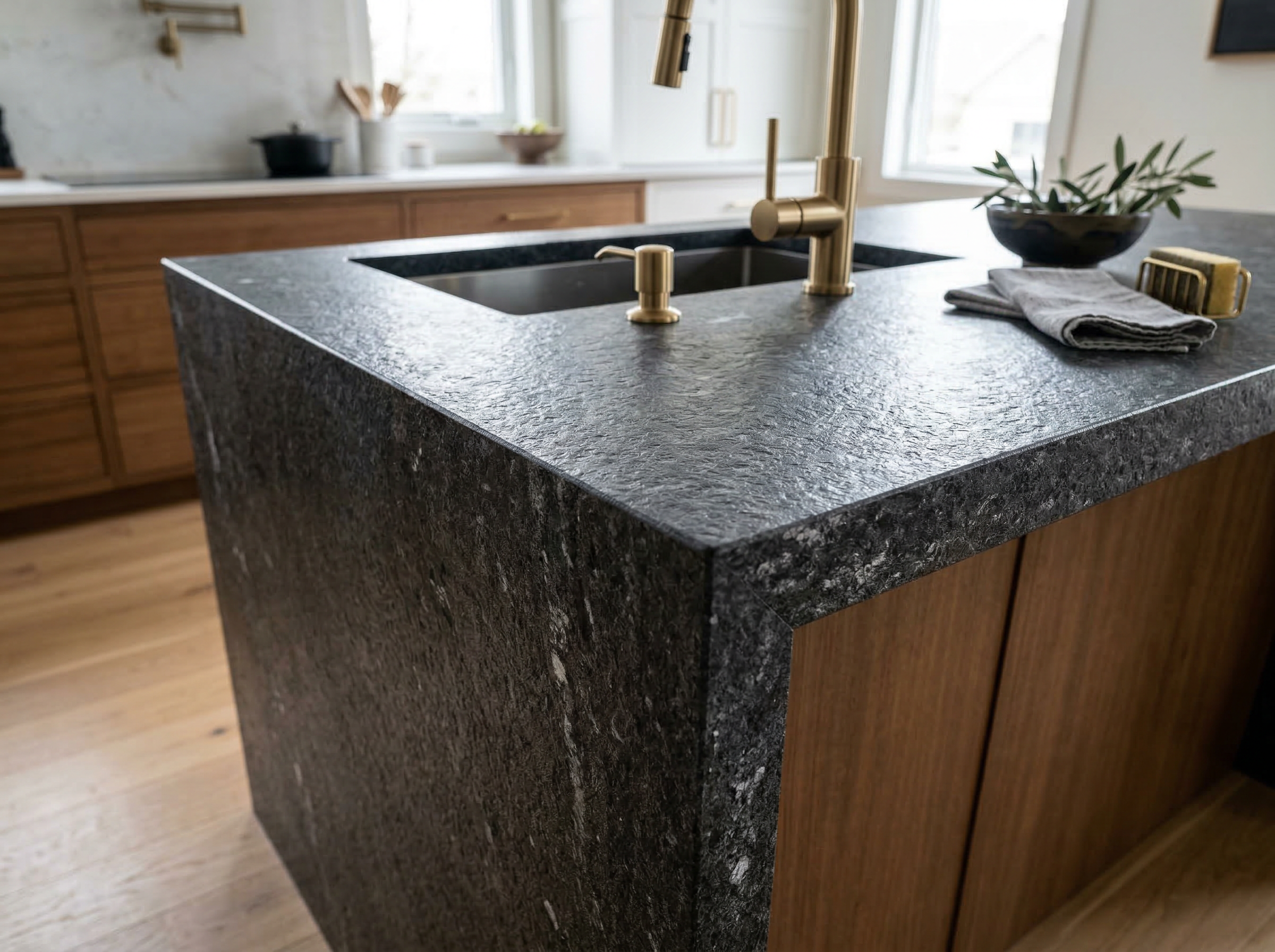
Granite wins here, and it's not close. You can set a 500-degree pan directly on granite countertops without worry — the stone formed under volcanic heat millions of years ago and handles thermal stress naturally. We've seen granite slabs survive house fires with barely a scorch mark.
Quartz is a different story. The resin binders that hold quartz together start to break down around 300°F. A hot pan straight from the stove can leave a white discoloration ring or even cause the surface to crack. These burn marks are permanent — there's no buffing them out. If you cook frequently and tend to set hot pots on the counter, granite has a meaningful advantage. Quartz users need trivets, every time, no exceptions.
This one comes down to personal taste. Granite gives you the real thing — natural movement, mineral flecks, unique veining that no other slab on earth will match. Every piece is one of a kind. If you pick a granite slab in our yard, that exact pattern is yours alone. The tradeoff is that you can't perfectly match seams on long runs because no two sections of the slab look identical.
Quartz gives you consistency. If you want a uniform white Calacatta look with predictable grey veining across a 14-foot island, quartz countertops deliver that. The engineering also means quartz comes in colors and patterns that don't exist in nature — concrete-look greys, solid blacks, even designs that mimic marble without marble's softness. For modern kitchens with clean lines, quartz tends to be the go-to.
In the Charlotte market, granite typically runs $40 to $60 per square foot installed. Quartz is slightly higher at $50 to $75 per square foot installed. The overlap means your final price often depends more on the specific color and pattern you choose than the material itself. Exotic granites like Blue Bahia or Patagonia can exceed quartz pricing, and entry-level quartz can compete with mid-range granite.
For a typical Charlotte kitchen with 40-50 square feet of countertop, you're looking at roughly $1,600–$3,000 for granite or $2,000–$3,750 for quartz, fully installed. Buying factory direct — like from The Granite House — saves 30-40% compared to showroom pricing on either material, because we cut out the middleman. We import our own slabs, fabricate in our own shop, and install with our own crew.
| Category | Granite | Quartz |
|---|---|---|
| Material Type | 100% natural stone | Engineered (93% quartz + resin) |
| Hardness (Mohs) | 6–6.5 | 7 (surface), but resin is softer |
| Heat Resistance | Excellent — handles hot pans | Poor — resin scorches at 300°F |
| Sealing Required | Yes — every 6–12 months | No — never |
| Stain Resistance | Good when sealed | Excellent — non-porous |
| Scratch Resistance | Excellent | Excellent |
| Uniqueness | Every slab is one-of-a-kind | Consistent, repeatable patterns |
| UV Resistance | Yes — safe outdoors | No — yellows in direct sunlight |
| Cost (Charlotte, installed) | $40–$60/sq ft | $50–$75/sq ft |
| Best For | Serious cooks, outdoor kitchens, natural stone lovers | Busy families, modern design, low-maintenance kitchens |
Want to see both materials in person?
Visit our Charlotte shop and compare slabs side by side. Visit our Charlotte shop →
Both granite and quartz add value to your Charlotte home. Real estate agents consistently rank kitchen countertops among the highest-return improvements — the National Association of Realtors puts the ROI on a kitchen remodel at 75% or higher in strong markets like Charlotte. Granite carries a prestige factor. The word "granite" still moves the needle in MLS listings, especially in established neighborhoods like Myers Park, Dilworth, and SouthPark where buyers expect natural stone.
Quartz has gained significant ground with buyers who prefer modern aesthetics and low maintenance, especially in newer developments in Ballantyne, Lake Norman, and Fort Mill. In Charlotte's competitive housing market, either material signals quality. The best choice for resale is the one that fits your home's overall design — a transitional kitchen with shaker cabinets might lean granite, while a sleek modern build might lean quartz.
Charlotte homeowners trend toward lighter tones in 2026. For granite, White Ice, Alaska White, and Colonial White are moving fast — we can barely keep these in stock. Giallo Ornamental remains a solid mid-range choice for warmer kitchen palettes. On the quartz side, Calacatta-inspired whites with grey veining dominate — they deliver the marble look without the maintenance headaches. Brands like Silestone, Caesarstone, and Cambria all offer their own Calacatta variations, and we carry most of them.
Darker options like Steel Grey granite and Charcoal Soapstone quartz remain popular for statement islands and wet bars. We're also seeing more leathered finishes on granite — that textured, matte surface hides fingerprints and water spots better than a polished finish, which makes it practical for heavy-use kitchens.
If you're building an outdoor kitchen — and plenty of Charlotte homeowners are — granite is your only real option between these two. Quartz cannot handle direct UV exposure. Over time, sunlight breaks down the resin binders and causes yellowing and fading. Most quartz manufacturers explicitly void their warranty for outdoor installations. Granite thrives outside. It handles sun, rain, Carolina humidity, and temperature swings without breaking a sweat. If you're looking at outdoor materials, also consider quartzite countertops — a natural stone that combines granite's durability with a marble-like appearance.
Based on what we see at our Charlotte fabrication shop, the split runs roughly 45% quartz, 40% granite, and 15% quartzite or other natural stone. Quartz has gained ground over the last three years, mostly driven by younger homeowners doing their first kitchen remodel. They want the clean white Calacatta look, they don't want to think about sealing, and they like that quartz is predictable.
Granite still wins with homeowners who cook a lot, anyone building outdoor kitchens, and buyers who want a truly unique slab that nobody else has. We also see granite dominate in higher-end custom builds in neighborhoods like Ballantyne Country Club and The Peninsula — those homeowners want natural stone and are willing to do the minimal maintenance.
The most common pattern we see: quartz on the perimeter countertops (for easy cleanup) and a granite or quartzite waterfall island as the centerpiece. That gives you the best of both worlds — low maintenance where you need it, and a showstopper natural stone where people actually look.
Both are excellent materials that will last decades and add real value to your home. Here's the quick version:
Choose granite if you want natural beauty, superior heat resistance, outdoor durability, and a one-of-a-kind slab. You'll need to seal it once a year — 10 minutes of your time.
Choose quartz if you want zero maintenance, consistent color, and a modern aesthetic. Just remember the trivets.
The Granite House carries both. Walk into our Charlotte shop, touch the slabs, and see them under real light — not a tiny sample square at a big-box store. We'll measure your kitchen, give you a free estimate, and have your countertops fabricated and installed in about a week. No pressure, no games. Just stone, honest pricing, and expert fabrication.
The Granite House — Charlotte NC
Factory-direct granite, quartz, quartzite and marble. Fabricated in our Charlotte shop, installed by our team. One honest price.
Get a free, no-pressure estimate from Charlotte's factory-direct countertop team.
GET A FREE ESTIMATE →